
How to Check Criminal History in Westmoreland County
No single Westmoreland County search contains every criminal record. Start with the free Unified Judicial System public docket search when the goal is to learn how a filed case moved through court. Use the county inmate roster for present custody, not for a full record of past arrests. Choose Pennsylvania Access To Criminal History, known as PATCH, when an official statewide name-based repository response is needed. A police narrative must come from the agency that investigated the event.
Gather the person's full name, spelling variants, approximate age, and any docket or incident number. Names alone can match more than one person. Compare the court, filing date, arresting agency, and charge details before treating records as related. Westmoreland County dockets can begin in a Magisterial District Court and later gain a CP-65-CR number in Common Pleas.
- Search UJS participant records in Westmoreland County and note the docket number, court type, status, and complaint number.
- Check the county prison roster if current custody or a recent booking matters.
- Order PATCH when a Pennsylvania repository certificate answers the question.
- Ask the arresting police agency for its incident report and use the Clerk of Courts for filings that are not online.
- Compare each charge disposition and seek a certified copy or subject Access and Review record when proof or correction is needed.
Four Westmoreland Criminal Record Counters
The clerk, sheriff, prison, and Pennsylvania State Police are not substitute counters. The Clerk of Courts keeps Common Pleas criminal dockets and filed papers. The sheriff handles courthouse security, transport, civil process, and warrants. Westmoreland County Prison creates booking and custody records. PSP's Central Repository assembles reportable arrest and disposition data from across Pennsylvania.
Clerk of Courts
2 North Main Street, Suite 203
Greensburg, PA 15601
724-830-3734
Sheriff
2 North Main Street, Basement
Greensburg, PA 15601
724-830-3457
County Prison
3000 South Grande Boulevard
Greensburg, PA 15601
724-830-6000
The official sheriff page shows the office's divisions and contact routes.
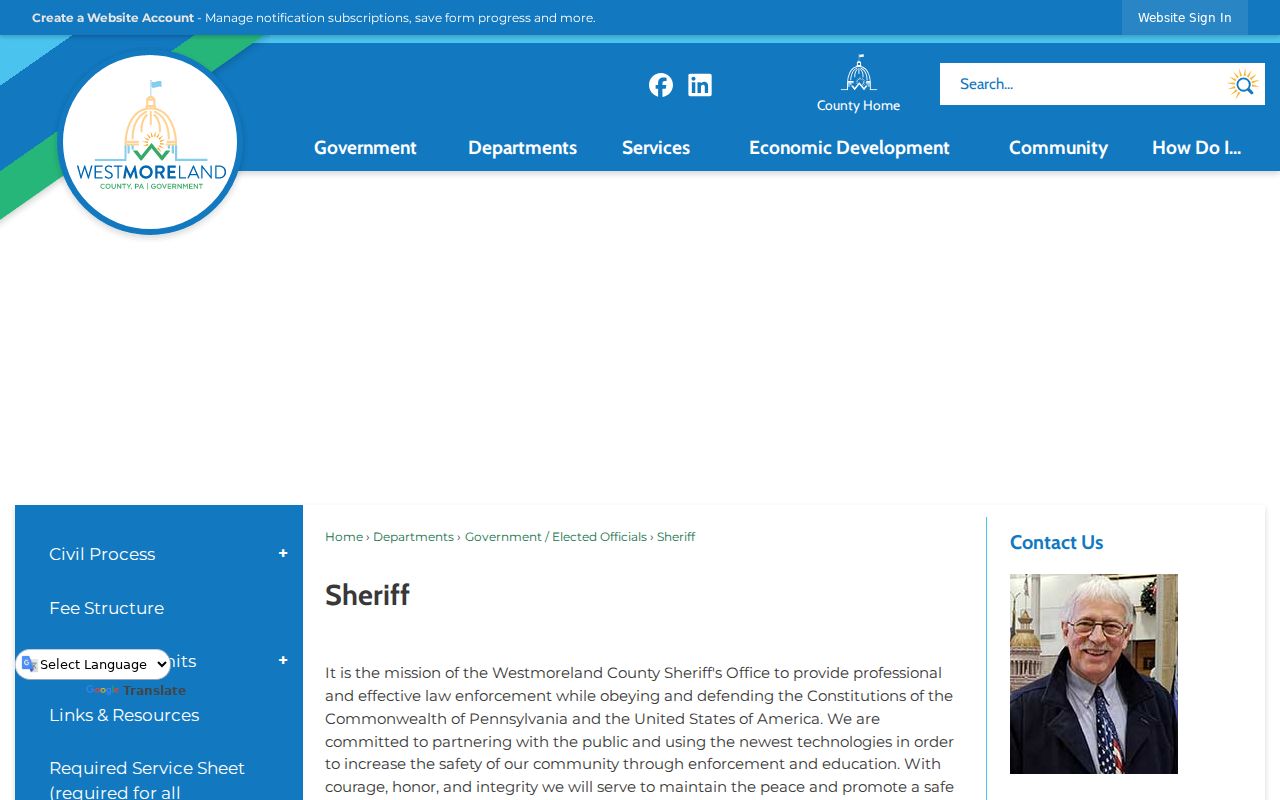
That division list helps route a warrant question to the sheriff without sending police-report or jail-record work to the wrong office.
Official Pennsylvania Background Checks
The Pennsylvania State Police Bureau of Records and Identification operates PATCH. A standard public name-based check costs $22, and notarization adds $5. The volunteer product is free but cannot be notarized. PATCH uses Pennsylvania law-enforcement criminal-history data. It is not a federal check, and it is not fingerprint-based.
For review of one's complete Pennsylvania repository record, including non-convictions, PSP directs the subject to the mail-only Individual Access and Review process with form SP 4-170 and a $20 fee. A separate FBI Identity History Summary costs $18 and requires fingerprints. Pennsylvania programs that require an FBI fingerprint check route applicants through IDEMIA/IdentoGO. Pre-registration is mandatory, and the program's service code controls the correct transaction.
The official PATCH request interface begins the state record check.
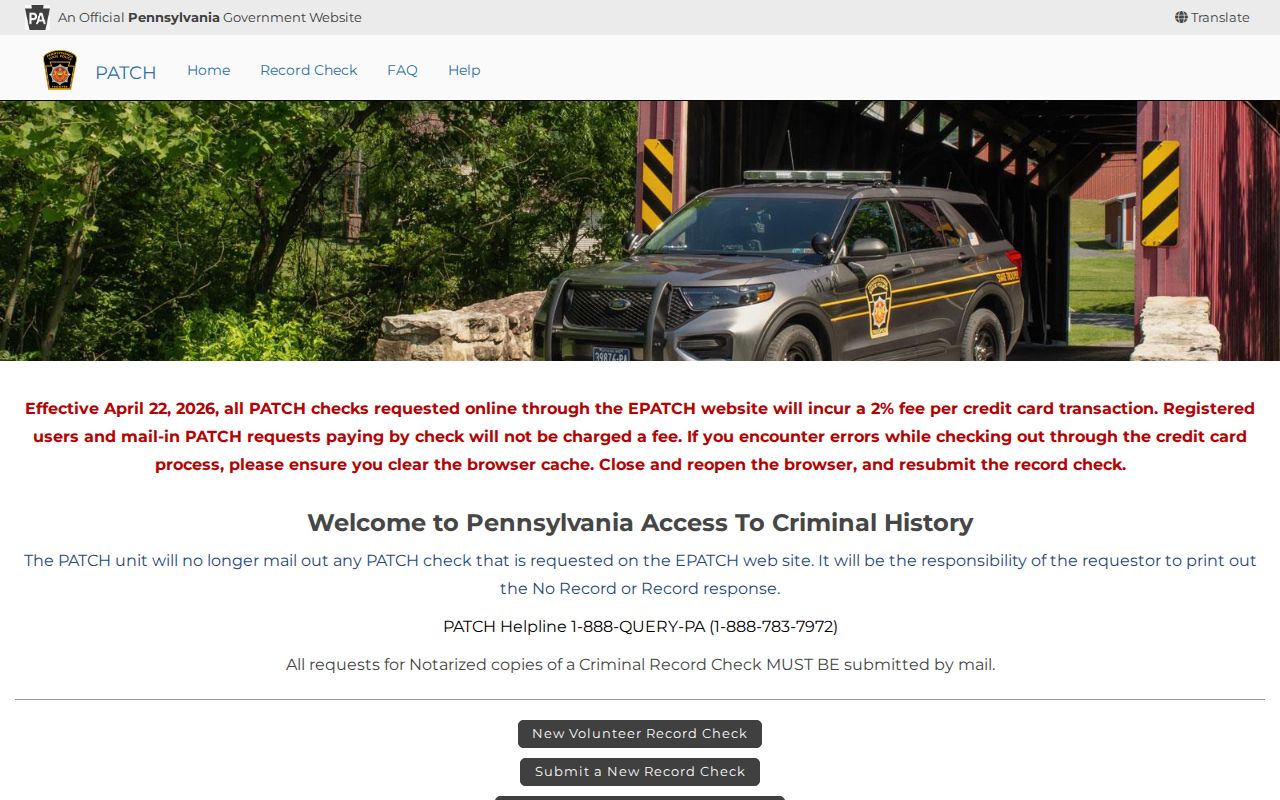
The screen represents a PSP repository request, which answers a different question from a Westmoreland County court docket or booking entry.
Westmoreland PATCH Criminal Check Status
PATCH can return “No Record,” “Request Under Review,” or “Record.” Under review does not prove that the subject has a criminal record. It means the identifiers may match repository data and PSP must inspect the request. Manual review may take two to four weeks. Save the control number, exact subject name, and request date because the status check relies on them.
A no-record certificate is also limited. It reflects the public Pennsylvania product and the identifiers supplied. It does not replace a subject's full Access and Review record, an FBI summary, or the court file. When a Westmoreland County disposition seems absent, compare the PSP entry with the UJS docket and obtain court proof before using the PSP correction route.
| PATCH field | Requirement | Use |
|---|---|---|
| Subject name | Required | Primary name match; include middle name and aliases when known |
| Date of birth | Required | Key identity match field |
| SSN, sex, race | Optional | May help narrow an identity match |
| Optional | Can provide notice when review is complete | |
| Control data | Keep after filing | Control number, exact name, and request date retrieve status |
Note: PATCH accepts up to ten requests per session, but each result still depends on the identity data entered for that subject.
Types of Criminal Records
Westmoreland County criminal records form a chain rather than one master file. Police create incident and arrest reports. The prison records intake and current custody. A Magisterial District Judge records the complaint, first arraignment, bail, and preliminary hearing. If charges are held for court, the Clerk of Courts maintains the Common Pleas case. PSP then depends on arrest and disposition reports to build state criminal-history information.
- Police report: allegations, officer action, narrative, and evidence details that may be restricted during an investigation.
- Booking entry: intake identity, time, initial charges, custody, bond, and release or transfer data.
- Court docket: filed charges, bail, events, pleas, outcomes, sentence, and financial entries.
- Warrant record: court authority to arrest or detain, with execution handled by law enforcement.
- Supervision or registry record: probation, parole, or statutory registration information with access limits of its own.
For the filed charge history and final outcome, the dedicated Westmoreland County criminal court case records explanation follows the Common Pleas file in detail.
Westmoreland County Warrant Record Fallback
Westmoreland County has no comprehensive public warrant portal documented in the research. The safe fallback begins with the Sheriff Warrant Division at 724-830-3462. A UJS docket may show entries such as “Bench Warrant Issued,” “Returned,” or “Lifted/Vacated,” but online entries can lag. A docket should not be used as proof that a warrant has cleared.
For one's own possible warrant, record the docket number, issuing court, charge, and bail status. Then contact counsel, the issuing Magisterial District Court, or the Warrant Division for current instructions. Search warrants and sealed warrants are not expected to appear before execution. Warrants from another county or a federal court must be checked with the issuing jurisdiction.
Current status matters: Call the Sheriff Warrant Division for official verification and surrender guidance instead of relying on a web docket alone.
What a Westmoreland County Criminal Record Shows
The fields depend on the source. A PSP rap sheet groups identifiers, arrest cycles, agencies, charges, reported dispositions, and sentences. It does not contain the officer's incident narrative. A UJS docket focuses on one case and may show counsel, bail, hearing dates, docket entries, each charge outcome, sentence, and financial balances. A booking record concerns intake and custody, so its charges can differ from the prosecutor's later filing.
| Name & Identifiers | Name, aliases, birth data, and state or federal identifiers where access rules allow |
|---|---|
| Arrest / Booking Data | Agency, incident number, arrest or intake date, holding facility, and initial charge data |
| Charges & Statutes | Offense, statutory section, grade, sequence, and later amendments or withdrawals |
| Disposition | Outcome for each charge, such as conviction, dismissal, withdrawal, acquittal, or nolle prosequi |
| Sentence | Confinement range, probation, credit, restitution, fines, costs, and stated conditions |
| Custody / Supervision | County custody, state incarceration, probation sentence, or state parole locator status |
Charge grade and outcome must be read as separate fields. Pennsylvania docket abbreviations include F1 through F3 for felonies, M1 through M3 for misdemeanors, and S for summary offenses. A felony grade beside a dismissed count is not a felony conviction. Supervision also needs context: Westmoreland County Adult Probation and Parole supervises county sentences, while Pennsylvania DOC field staff supervise release from state incarceration. The Common Pleas docket supplies the imposed sentence, but operational supervision notes may be restricted.
- Disposition
- The recorded outcome of a charge or court proceeding.
- Held for court
- An MDJ ruling that sends charges onward to the Court of Common Pleas.
- Nolle prosequi
- The prosecutor's formal decision not to continue a charge, subject to court procedure.
- Limited access
- A restriction that removes qualifying records from ordinary public view without erasing every authorized use.
Westmoreland County Prison Record Limits
The county's free roster is a browse-first alphabetic list. A user accepts a CHRIA disclaimer, then chooses A through Z or All. It is not a modern search form with date-of-birth or booking-number filters. Common names can be hard to separate, and the county does not promise real-time completeness. A blank result may mean release, transfer, spelling trouble, or a delay rather than no arrest.
Westmoreland County Prison holds county custody records. The Pennsylvania Department of Corrections locator covers state incarceration and state-supervised people, not those still in the county jail. Once someone leaves the current roster, use the UJS case record for the court trail and the DOC locator after a state sentence. Call the prison when the public list does not settle current custody. The fuller Westmoreland County arrest history route also identifies report custodians and recent-booking fallbacks.
Roster charges are intake allegations. They may be changed, withdrawn, or replaced and do not prove guilt.
Public Access Laws
Public access in Westmoreland County turns on both the record and its custodian. The Pennsylvania Right-to-Know Law creates a presumption for agency records but retains exemptions, including criminal-investigative material. Court dockets follow Unified Judicial System policy, not the county executive request route. Pennsylvania's Criminal History Record Information Act, or CHRIA, controls repository dissemination, correction, and expungement.
Key Statutes:
Pennsylvania Right-to-Know Law sets the agency-record request and appeal framework.
18 Pa.C.S. Chapter 91 governs criminal-history dissemination, correction, expungement, and limited access.
UJS public access policies govern judicial case and financial records.
42 Pa.C.S. Chapter 97 controls registration, verification, public registry data, and related offenses.
The county Open Records page provides the executive-agency route.
Its request process does not replace a docket order from the Clerk of Courts or a police request sent to the agency that wrote the report.
Westmoreland Criminal Record Request Fees
A written county Right-to-Know request may be emailed, mailed, faxed, or delivered in person to the Open Records Officer. It should describe the record with enough detail to find it. The requester may ask to inspect, receive copies, or receive certified copies. Written filing preserves appeal rights, and the request does not need to explain why the information is sought.
| County request item | Published amount |
|---|---|
| Standard black-and-white copy | $0.25 per side |
| Certification | $1 per record, apart from notarization |
| Specialized media and postage | Actual cost |
| Redaction or ordinary search time | No fee |
| Expected total above $100 | Prepayment may be required |
The official Westmoreland County fee schedule is the source for those amounts.
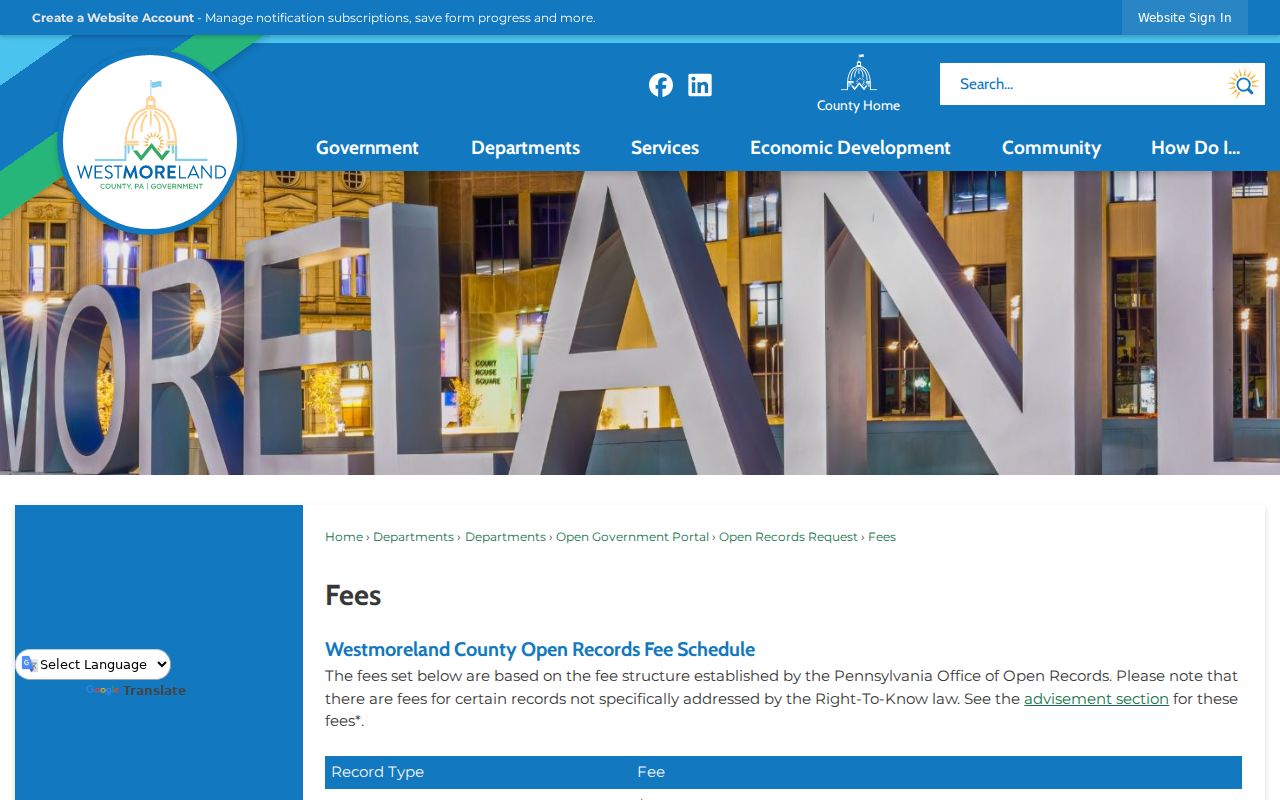
The schedule is useful only after the proper custodian has been found, since police, court, PSP, and county executive records use different routes.
Sealed, Expunged & Restricted
Westmoreland County public files exclude or redact Social Security numbers, full account numbers, protected victim and minor information, and other policy-protected identifiers. Juvenile records have much narrower access. Active investigative facts, confidential sources, evidence, and victim material may be withheld under the Right-to-Know Law. Limited access hides qualifying records from ordinary public dissemination but does not destroy all authorized access.
Pennsylvania law provides expungement under 18 Pa.C.S. § 9122, petition-based limited access under § 9122.1, and automatic Clean Slate limited access under § 9122.2. Eligibility depends on the record and statutory conditions. ARD completion can support expungement in qualifying cases, but the case does not vanish merely because a diversion program ended. Start with the docket and the local form that matches the record.
Westmoreland County Expungement Filing Path
Westmoreland County publishes separate forms for ARD expungement, criminal-offense expungement, summary-offense expungement, juvenile expungement, and a petition for limited access. Every expungement form must first be filed with the Clerk of Courts. The District Attorney will not accept a petition that has not been clerk-filed.
The county lists a $159.44 petition fee and charges $0.25 per page for hard-copy docket sheets. It also warns that implementation by all criminal-justice agencies can take up to six months after an order. An order does not remove a PennDOT driving history or third-party web content. Fees can change, so confirm the amount with the clerk before filing.
After the stated implementation period, compare UJS, one's PSP Access and Review response, and the responsible agency records. If official data remains, use the order and court documents through the reporting agency or PSP correction channel.
Westmoreland Criminal Records Since 1908
Westmoreland County was formed in 1773, and its courthouse record system has a strong physical history. County accounts identify courthouse buildings from 1798 and 1854. The third building came down in 1901. The present Beaux-Arts courthouse was erected in 1906 and dedicated on January 31, 1908. Current criminal files still connect that Greensburg center to a network of Magisterial District Courts and police departments spread across more than one thousand square miles.
The county courthouse history illustrates that local setting.
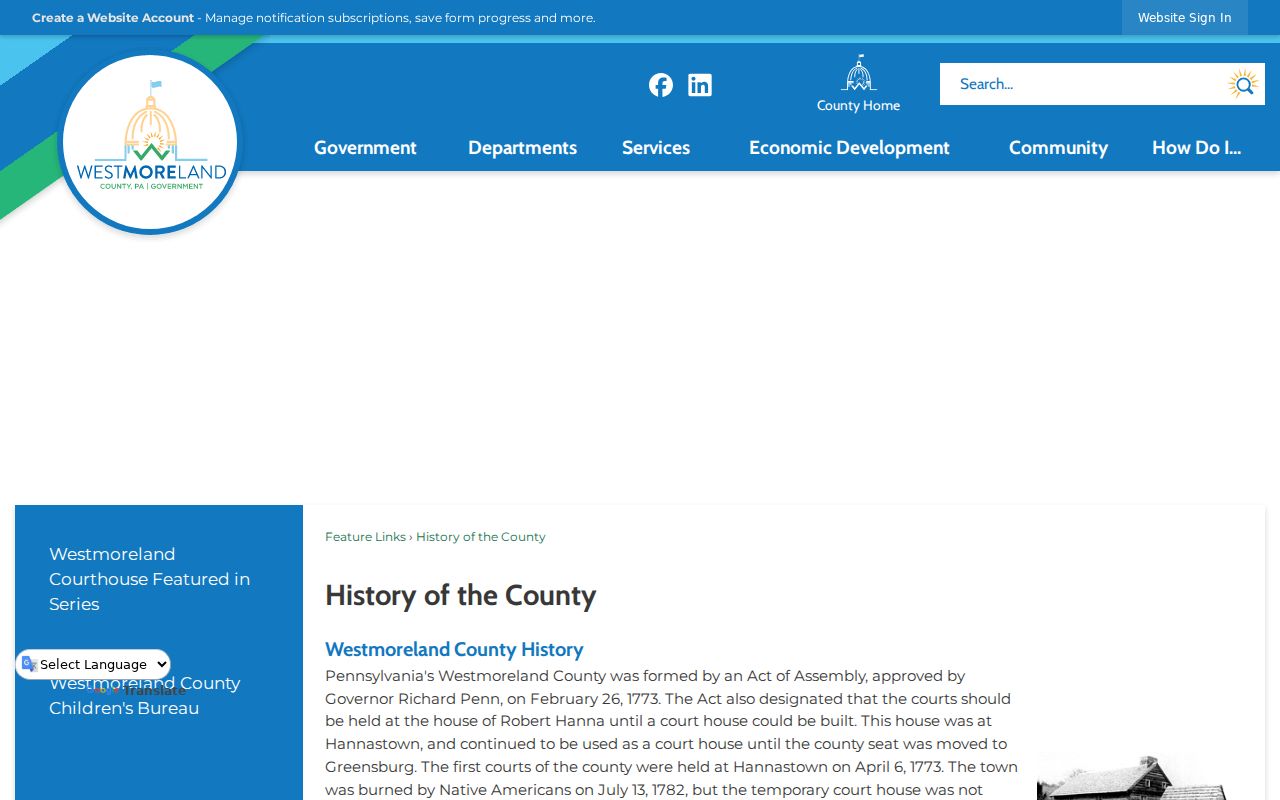
Electronic UJS docket sheets now overlay paper and archived clerk files, but record ownership still follows the office and case stage.
Westmoreland County Federal Criminal Records
Federal cases involving Westmoreland County do not appear in Pennsylvania UJS. They belong to the U.S. District Court for the Western District of Pennsylvania. PACER provides federal docket access after registration, while sealed documents remain unavailable. The federal Bureau of Prisons locator covers federal custody and is separate from both the Westmoreland County roster and the Pennsylvania DOC locator.
The Western District's official site identifies the federal court and clerk channel.
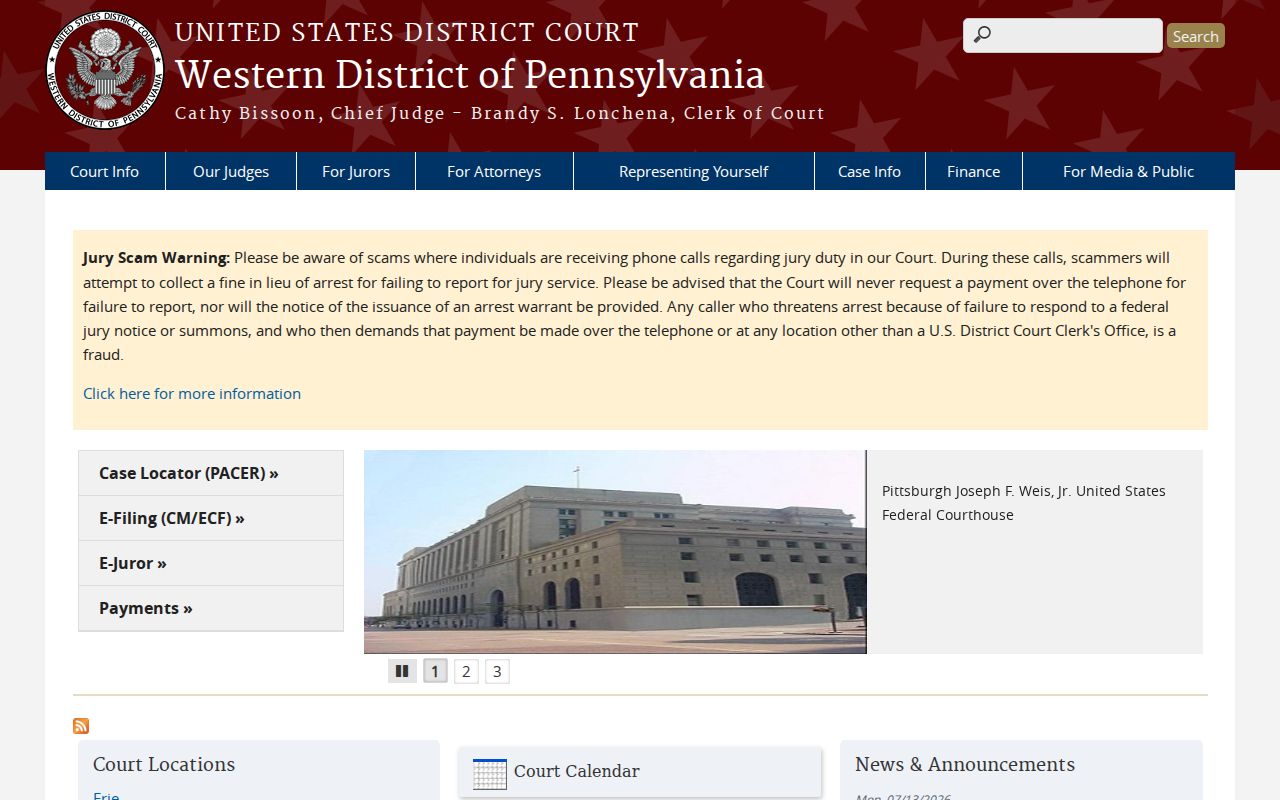
This federal layer matters when a name appears in PACER but not in a Westmoreland County or Pennsylvania court search.
Criminal Records by City in Westmoreland County
City police departments retain their own incident records even when bookings, court files, and state repository entries later move through county or Pennsylvania systems. Westmoreland County's three largest incorporated places therefore have distinct starting points. Murrysville routes reports through its municipal police department, Greensburg separates city police records from nearby county courthouse records, and New Kensington keeps city-created incidents with its own police custodian.
Murrysville Criminal History
Largest incorporated place, with municipal police reports and MDJ 10-3-02 records
Greensburg Criminal History
County seat, with separate city police, county court, and prison record channels
New Kensington Criminal History
City police incidents paired with county booking and UJS court records